Retail Media's Next Winner Isn't a Retailer. It's the Bank.
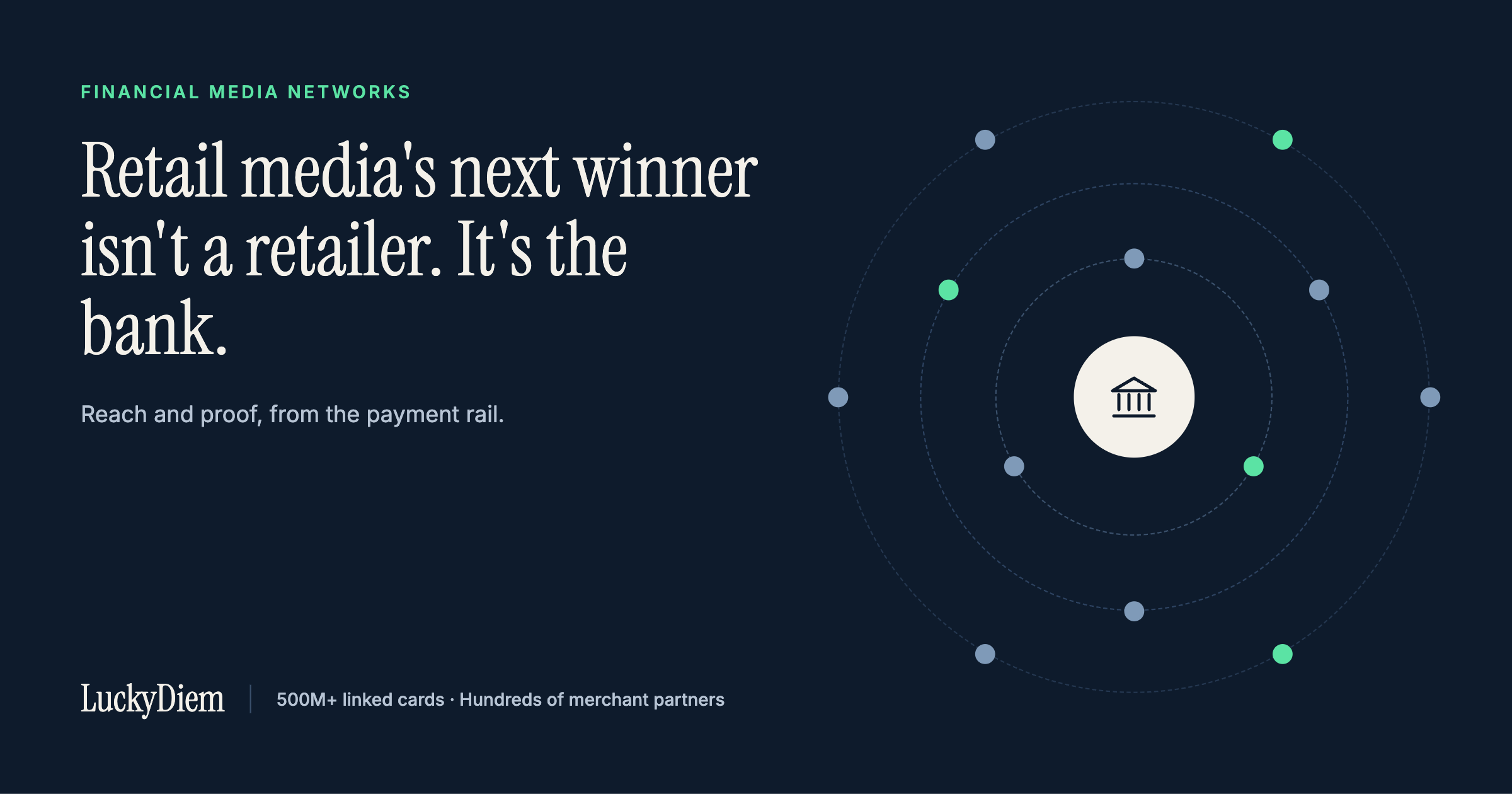
Retail media has a reach problem and a proof problem. Financial media networks solve both.
Retail media networks have spent years expanding beyond their own sites into social, search, connected TV and the open web. EMARKETER projects US off-site retail media spend will grow from $17.98 billion in 2026 to $35.57 billion by 2030.
But look at where the money actually lands. Only about $1.30 billion of social ad spend will flow through retail media networks in 2026. That's under 2% of retail media spending. Advertisers already buy those channels directly, and access alone doesn't give them a reason to add another middleman.
The question that matters is whether the data improves the media they're already buying.
The retailer's data problem
A retailer knows what happens in its own stores and on its own site. That's valuable, but it's a keyhole. Shoppers move between social feeds, search, AI assistants and physical stores. Target's own digital team notes that nearly half of purchases that begin with ecommerce browsing finish in a store.
An advertiser trying to understand a customer needs the whole picture: who buys my brand, who buys my competitor. A single retailer can only answer part of that.
What a financial media network sees
A card-linked offer platform sits on the payment rail. LuckyDiem connects hundreds of merchant partners to over 500 million linked cards through major banks and payment networks. Those cards transact everywhere. The data isn't limited to one retailer's four walls.
That changes three things.
1. Reach without a new workflow. Offers appear inside the banking and card experiences consumers already use. Advertisers don't need a new buying process, a new measurement stack or a new budget owner.
2. Measurement that's closer to proof. EMARKETER's coverage of this space makes a point we agree with: tying an ad to a transaction isn't the same as proving the ad changed behavior. Advertisers want to know whether they're winning incremental customers, not just crediting sales that would have happened anyway. Card-linked offers are built around new customer acquisition. A brand pays when a new customer buys, not when an impression is served.
3. Neutral, cross-merchant intelligence. The payment rail sees spend across categories and competitors. That's the kind of purchase intelligence the industry is trying to build from retailer data, but with a wider lens.
Why this sector wins
Retail media is moving from a land grab to an accountability era. The networks that win will be the ones that can show verified, incremental results, not just reach. Financial media networks start with the strongest asset for that: transaction-level truth, closed-loop attribution and consumer trust built through the banks people already rely on.
Social and search will keep growing, and retailers will keep investing. But when budgets get scrutinized, the networks that can prove incrementality will take a larger share. We think that's financial media.
Want to see it in action? Talk to us about a pilot.
Source: EMARKETER, "Retail media must prove how retailer data improves advertising beyond owned channels," Oct. 15, 2026.
Interested in learning more?
Get in touch to explore how LuckyDiem can work for your brand.
Contact Us